

Agent Observability
Governance Signals
GGX investigates LLM traces every 15 minutes and files findings for PII leaks, error spikes, silent failures, retry loops and cost outliers, linked to risk assessments.
GGX investigates your traces every 15 minutes and files a finding when it sees a risk. Each finding is tied to the deployment, agent version and model it concerns, so it can follow the model into its risk assessment rather than stop at an engineer’s inbox.
What GGX looks for
Section titled “What GGX looks for”| Investigator | Files a finding when |
|---|---|
| PII leak | Stored content still contains personal data, or a project stores content unmasked. Critical when capture is Full. |
| Error spike | The error rate rises well above its level over the previous day. |
| Silent failure | A step fails under a step that reports success, or fails with no error detail. |
| Instrumentation gap | A model’s calls report no token usage, or calls do not name their model. |
| Retry loop | Agents repeat the same tool call. |
| Cost outlier | Runs cost far more than usual for their kind. |
| Evaluator regression | An evaluator’s results over the last day are worse than over the week before. |
| Monitor alert | A monitor set to open findings starts alerting. |
Findings never quote trace content. They carry counts, the time window, links to example traces, and the names of the assets involved.
Working a finding
Section titled “Working a finding”Open Tracing → Signals. Tiles count open findings by severity, and the list can be filtered by status and investigator. Opening a finding shows its narrative, evidence, linked assets and history.
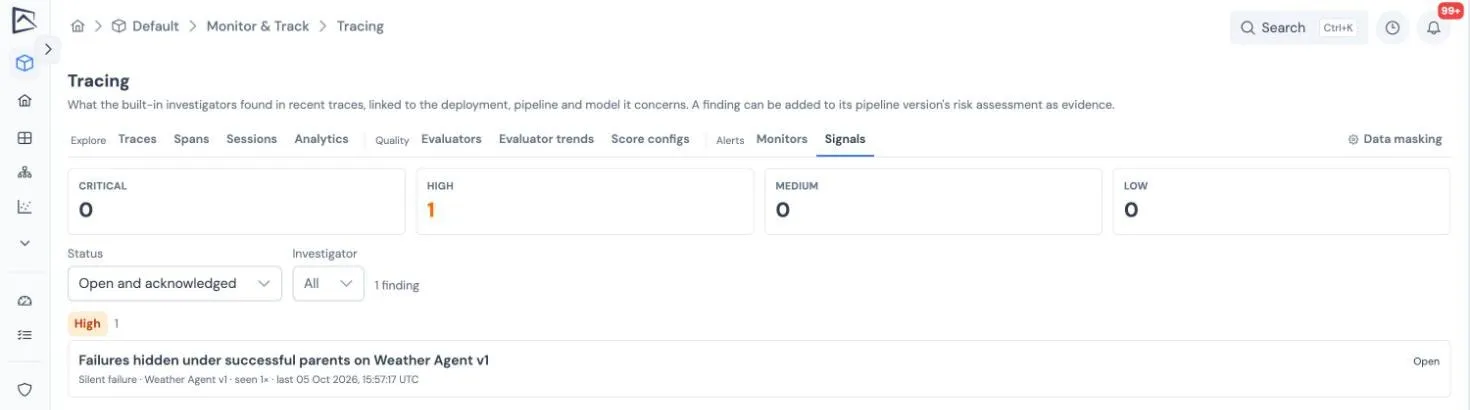
- Status: open, acknowledged, resolved or dismissed. Resolving or dismissing needs a reason, and every change records who, when and why. A finding can be reopened and assigned to someone.
- Repeats: if the same problem recurs while a finding is open, GGX updates it (occurrence count, evidence, and severity only ever rises) rather than filing another.
- Resolved means fixed: if the problem comes back, it is a new finding.
- Dismissed means accepted: recurrences are added to the dismissed finding quietly, and it reopens only if the problem becomes more severe.
- Notifications: new critical and high findings notify the project’s members in GGX, and assigning a finding notifies the assignee.
Findings in governance
Section titled “Findings in governance”- A Trace signals panel on agent and deployment pages lists the open findings that concern them, so approvers see them.
- Add to risk assessment records a finding in the agent version’s risk assessment under a suggested category and risk (a PII leak goes under data leakage, for example), keeping the assessor’s own text.
- Deleting a deployment, agent version or model keeps its findings and unlinks them.
What to read next
Section titled “What to read next”- Monitors: thresholds you set yourself, which can also open findings.
- Data masking: the policy the PII leak investigator checks against.
- Approval workflows: where approvers review an agent before it ships.