GenGuardX (GGX) is where enterprises test, approve, and monitor high-stakes GenAI. It gives business teams confidence before launch, risk teams evidence at approval, and both continuous visibility in production — one shared environment that takes a GenAI solution from pilot to production and keeps it trustworthy once it is there.
Designed by veterans of risk management in regulated industries, GGX is a Responsible AI governance platform that is industry-agnostic and already running in production at a Tier 1 global bank, a leading US health system, and a major credit union — and is SOC 2 Type 2 certified.
The industry problem: 95% of GenAI pilots never reach production
Most GenAI initiatives stall after the proof-of-concept. Roughly 95% of GenAI pilots never reach production, leaving a wide gap between AI spend and realized business value. The result is pilot purgatory: the demo works, but nobody will sign off on exposing customers to it. The hard part isn’t building the application — it’s establishing enough business and risk confidence to approve it, in exactly the high-stakes, customer-facing use cases that carry the highest ROI.
Before a GenAI application can go live, two teams have to say “yes” — and most pilots stall because neither has the right tools to get there.
The business blocker
“Does the AI do what it’s supposed to?” Business owners own the experience but are often sidelined during technical testing.
Trust gap — no hands-on way to validate AI behaviour before it reaches customers.
Reputation risk — logic errors and hallucinations become public brand liabilities.
Unclear readiness — no objective proof that the AI is ready for production.
The risk blocker
“Is the AI blocking what it shouldn’t do?” Risk and legal teams need more than a demo — they need evidence.
Novel risks — bias, data leakage, and jailbreak attempts.
No evidence trail — subjective testing is hard to defend to audit and regulators.
No thresholds — no clear, measurable definition of “safe”.
And approval isn’t a one-time event: after launch, inputs drift, LLMs update, and third-party agents shift — so confidence has to be maintained, not just earned once.
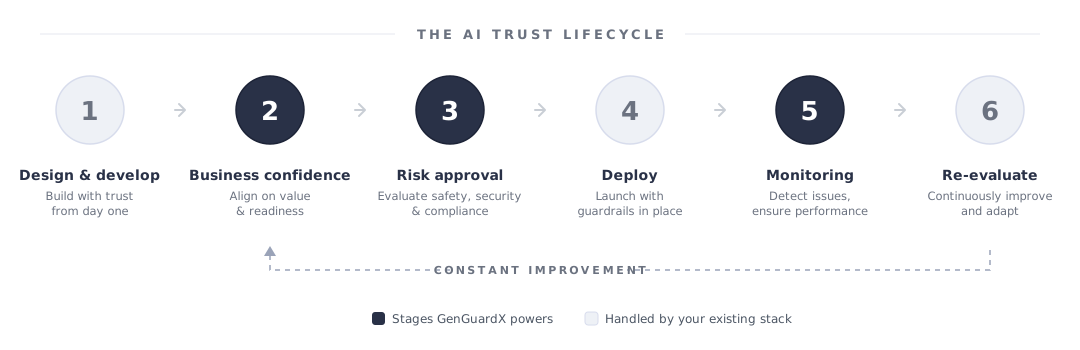
The AI trust lifecycle. GenGuardX powers the three stages where pilots most often stall — business confidence, risk approval, and ongoing monitoring.
GGX turns trust into a repeatable process. Instead of a one-time sign-off, it gives each team a structured way to build — and maintain — confidence across the lifecycle:
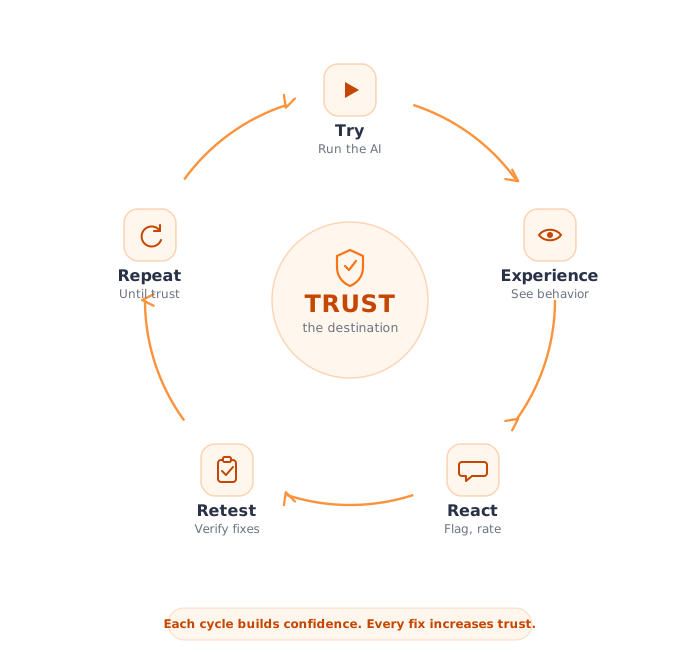
GGX gives your Subject Matter Experts a safe environment to stress-test scenarios, flag behavioural gaps, and verify fixes before the AI reaches a single customer. Every interaction follows a simple loop — try, experience, react, retest, repeat — and every cycle builds trust.
Every cycle builds confidence; every fix increases trust.
Interactive playground
Business users run realistic scenarios against the AI application before launch — no developer required.
Feedback portal
One-click flagging, ratings, and structured findings on every interaction.
Findings database
Every issue tracked from raised to resolved — no scattered feedback lost.
Progress tracking
Version-over-version proof that issues are being fixed.
GGX turns GenAI risk review into a repeatable workflow run against curated datasets, expected outputs, and thresholds — not one-off scripts. Every asset is versioned, every decision moves through an approval workflow with an audit trail, and an approved agent is locked, so the artifact that was signed off is the artifact that ships.
1 · Identify
Map use-case-specific risks: accuracy, stability, bias, toxicity, privacy leakage, groundedness, prompt injection, jailbreaking, dark patterns, and agent tool use.
2 · Measure
Run standardized, reproducible evaluations against curated datasets, policies, and thresholds.
3 · Mitigate
Apply guardrails, prompt changes, or routing logic, then prove the gap was closed.
4 · Monitor
Watch for drift, threshold breaches, and new failure modes after deployment.
This framework aligns with emerging standards such as the EU AI Act and the NIST AI Risk Management Framework, and produces results that are auditable, reproducible, and comparable — backed by a risk library, standardized reports, and a controlled evaluation environment.
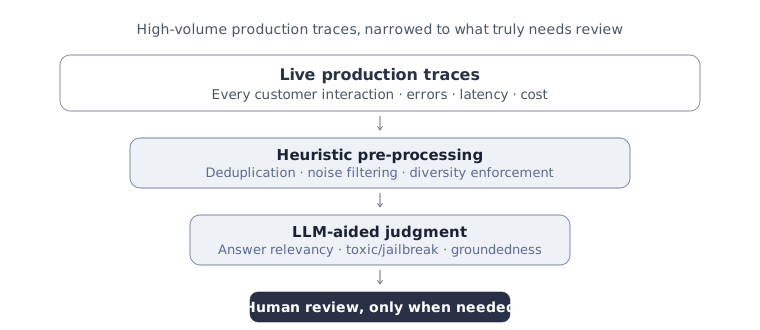
Approval isn’t the finish line, and monitoring isn’t just another dashboard. GGX evaluates high-volume production traces, surfaces only what truly needs a human’s attention, and turns what reviewers find into alerts, findings, and new ground truth.
From every customer interaction down to the few that truly need a human reviewer.
For the business team
See when AI behaviour drifts from the approved version — before it becomes a reputational issue.
For the risk team
Track threshold breaches, new failure modes, and control performance in production, with audit trails.
For both
Production findings become new test cases and approval evidence, feeding the next cycle of refinement.
GGX organizes everything into three stages, with agent observability across live traffic. Explore the documentation for each:
Register & RefinePoint-and-click building of GenAI apps, with prompt, RAG, and agent optimization.
Evaluate & ApproveStandardized and custom testing, human-in-the-loop dashboards, and approval tracking.
Deploy & MonitorDirect-to-production deployment with continuous monitoring and alerts.
Agent ObservabilityEvery LLM call, tool call, retrieval, and autonomous agent decision in production, with evaluators, monitors, and governance signals.
In July 2025, GenGuardX — together with Oliver Wyman and Google Cloud — launched the GenGuardX Responsible AI Sandbox, a guided cohort program where enterprises run real use cases through the full AI lifecycle with governance and AI-risk experts in the room. Building on the earlier Project GGX collaboration, the Sandbox is hosted on Google Cloud’s secure infrastructure (including Vertex AI and Gemini), and participants can also bring their own tools and LLMs. The first cohort focuses on customer-facing Conversational AI for U.S. financial institutions.